
Ever wandered through a restaurant kitchen and noticed how fast those dishwashers run? The idea of installing a commercial-grade dishwasher at home is tempting, especially if you’re hosting large gatherings or running a small catering business from your kitchen. But commercial dishwashers aren’t just beefed-up versions of residential models. They operate differently, require specific infrastructure, and come with trade-offs that most homeowners don’t anticipate. Before you start shopping for a restaurant-style unit, it’s worth understanding what you’re actually getting into, and whether your home can handle it.
Table of Contents
ToggleKey Takeaways
- Commercial dishwashers complete cycles in 2–3 minutes using 150–180°F water for heat sanitization, unlike residential models that require 90–120 minutes but offer better energy efficiency.
- A restaurant dishwasher installation requires significant infrastructure upgrades including a dedicated 208–240V electrical circuit, commercial-grade water heater, and upgraded drain lines, totaling $3,500–$8,000.
- Commercial units operate at 70–85 decibels without sound insulation, lack drying cycles, and demand professional maintenance, making them impractical for most homeowners without a food business.
- High-performance residential dishwashers from brands like Miele and Bosch offer sanitizing cycles, express wash options under 30 minutes, and NSF-certified cleaning without the installation complexity of commercial models.
- A restaurant-style dishwasher only makes financial and practical sense if you’re running a licensed food business, frequent catering, or need rapid glassware turnover for large events.
What Makes Restaurant Dishwashers Different from Home Models
Commercial dishwashers are built for speed, not capacity. A typical home dishwasher holds 12–16 place settings and runs a full cycle in 90–120 minutes. A restaurant unit processes far fewer dishes per load, often just one or two racks, but completes a cycle in 2–3 minutes. That’s because commercial models use much hotter water (150–180°F rinse temperatures) and rely on sanitizing through heat rather than detergent soaking.
They also require a constant supply of hot water at high pressure. Most residential water heaters can’t keep up. A commercial dishwasher pulling 20–40 gallons per hour will drain a 40-gallon residential tank mid-cycle, leaving you with cold showers and incomplete rinse cycles.
Another key difference: no drying cycle. Commercial units sanitize dishes with such high heat that items air-dry almost instantly when removed. There’s no heating element or fan system like you’d find in a home model. The assumption is that dishes go straight from the machine to service or storage.
Finally, commercial dishwashers lack the sound insulation and vibration dampening that make residential models kitchen-friendly. Expect 70–85 decibels during operation, roughly the noise level of a garbage disposal running constantly. That’s fine in a bustling restaurant kitchen, but it’ll dominate conversation in an open-concept home.
Types of Commercial Dishwashers and Their Features
Commercial dishwashers come in several configurations, but only a few make sense for residential use.
Undercounter and High-Temperature Models
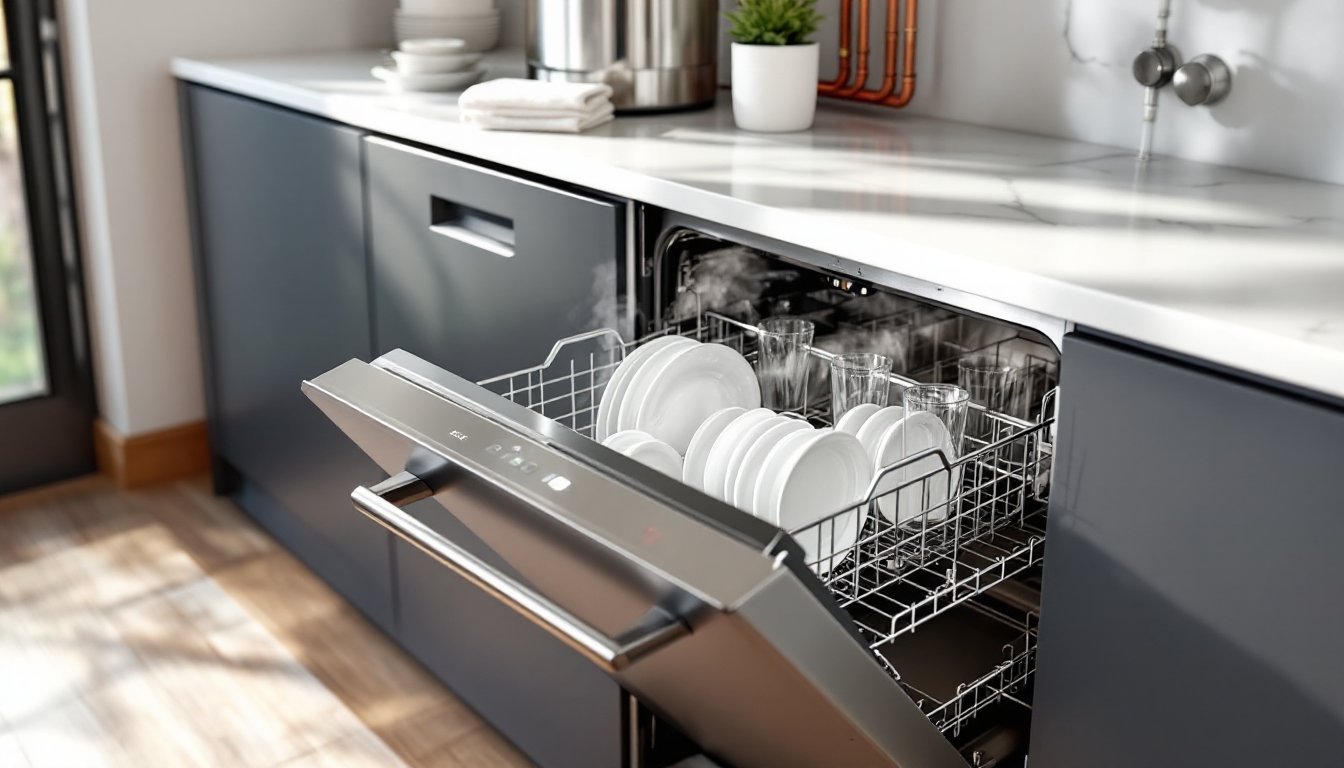
Undercounter commercial dishwashers are the most realistic option for home installation. They’re roughly the size of a residential unit (24″ wide) and fit beneath a standard countertop. These models wash one rack at a time, typically 16–20 plates or an equivalent mix of glassware and utensils, in 2–3 minutes. Brands like CMA, Hobart, and Jackson dominate this category.
You’ll choose between low-temp and high-temp models. Low-temp units use chemical sanitizing (chlorine or quaternary ammonium) and require water heated to only 120–140°F. They’re cheaper to install and easier on residential plumbing, but you’ll need to handle and store sanitizing chemicals. High-temp models use a 180°F rinse to sanitize without chemicals, but they demand a commercial-grade water heater or a booster heater to maintain temperature.
Door-style (pass-through) dishwashers are larger and designed for high-volume operations. They’re installed in a wall or partition so dirty dishes enter from one side and clean dishes exit the other. These units make zero sense for a home unless you’re running a licensed commercial kitchen.
Conveyor dishwashers, the kind you see in cafeterias, are massive, expensive, and require dedicated drain and utility runs. Skip these entirely for residential use.
When a Restaurant-Style Dishwasher Makes Sense for Your Home
A commercial dishwasher is worth considering if you’re running a legitimate food business from home, catering, a cottage food operation, or a licensed rental kitchen. Many jurisdictions require NSF-certified commercial equipment to meet health department standards. In that case, it’s not optional.
It also makes sense if you host frequent large events and need to turn around glassware and flatware quickly. A two-minute cycle means you can wash, dry, and reuse items mid-event without stockpiling duplicates. For example, hosting a wine-tasting event for 30 people with only 12 glasses becomes manageable.
Some serious home cooks prefer the faster turnaround for prep dishes during multi-course meal prep. If you’re the type to dirty five mixing bowls, three cutting boards, and a dozen prep containers before the entrée hits the oven, rapid washing keeps your workspace clear.
But if your primary goal is just “better cleaning,” a commercial unit won’t deliver. Modern high-end residential dishwashers from Miele, Bosch, or Thermador offer comparable cleaning performance with better energy efficiency, quieter operation, and no infrastructure headaches. As noted by kitchen experts at The Kitchn, residential dishwashers have advanced significantly in wash performance and cycle customization.
Installation Requirements and Costs to Consider
Installing a commercial dishwasher at home isn’t plug-and-play. Start with the electrical supply. Most undercounter models require a dedicated 208–240V, 30–50 amp circuit, far more than the standard 120V, 15-amp circuit used by residential dishwashers. You’ll need a licensed electrician to run new wiring from your panel, and if your panel is already maxed out, you’re looking at a panel upgrade ($1,200–$2,500).
Water supply is the bigger challenge. High-temp commercial dishwashers need water at 140–160°F entering the machine, then boost it internally to 180°F for the final rinse. A residential water heater set to 120°F (the standard for safety) won’t cut it. Options include:
- Installing a commercial water heater (40–80 gallons, $800–$2,000)
- Adding a booster heater near the dishwasher ($400–$1,200 plus installation)
- Raising your whole-house water heater temp (not recommended due to scald risk)
Drainage also differs. Commercial units often discharge water at a higher flow rate than residential drains can handle. You may need to upsize the drain line to 1.5–2 inches and ensure proper venting per plumbing code.
Permits are likely required for electrical, plumbing, and possibly mechanical work. Costs vary widely by region, but expect $500–$1,500 in permit fees and inspections. If you’re modifying a home kitchen for commercial use (even part-time), your local health department may get involved, triggering additional requirements like a three-compartment sink, separate hand-washing station, and grease trap.
All-in, a commercial dishwasher installation can run $3,500–$8,000 including the unit, infrastructure upgrades, and labor. Compare that to a high-end residential model ($1,200–$2,500 installed), and the economics only work if you have a business case.
Maintenance and Operating Considerations
Commercial dishwashers are designed for daily professional maintenance. That means descaling the booster heoster monthly, checking spray arm jets for clogs, inspecting door gaskets, and replacing worn parts promptly. Miss a maintenance window, and you’ll face costly downtime or health code violations, neither of which is a big deal at home, but both of which defeat the purpose of owning commercial equipment.
You’ll also go through detergent and rinse aid faster than you expect. Commercial detergents are sold in bulk (5-gallon pails) and are highly concentrated. Low-temp models require sanitizing chemicals that must be monitored and replenished. If you’re not buying in bulk or don’t have storage space for commercial supplies, per-load costs add up quickly. For comparison, reviews of dishwasher detergent options show residential tablets costing $0.15–$0.30 per load, while commercial detergent can cost $0.50–$1.00 per cycle depending on concentration.
Water and energy use are also higher. A commercial undercounter dishwasher uses 0.75–1.2 gallons per rack. Run it 10 times a day during a party, and you’ve used 12 gallons of hot water, plus the electricity to heat it. Residential models use 3–5 gallons per full load, which holds far more dishes.
Noise is another daily consideration. If your dishwasher runs during meals or conversation, the constant 75-decibel drone will be disruptive. You can’t just hit “start” and forget it like a residential model.
Repairs require commercial appliance technicians, who charge premium rates and may not service residential addresses promptly. Parts are expensive and often must be ordered. A failed heating element or pump in a home dishwasher might cost $150–$300 to fix: the same repair on a commercial unit can run $400–$800.
Alternatives: High-Performance Residential Dishwashers
If you want faster, more powerful cleaning without the infrastructure headaches, consider high-performance residential dishwashers. Models from Miele, Bosch 800 Series, and Thermador offer:
- Express cycles as short as 30 minutes (not 2 minutes, but far faster than standard 2-hour cycles)
- Sanitize options that meet NSF/ANSI Standard 184 (the same standard commercial units meet)
- Third racks for utensils and small items, effectively increasing capacity
- Adjustable racks that handle oversized pots, baking sheets, and mixing bowls
- Quiet operation (40–44 decibels, comparable to a library)
These models run on standard 120V electrical, connect to existing hot water supplies (120°F is fine), and install in the same footprint as your current dishwasher. No permits, no panel upgrades, no booster heaters.
For genuine speed, some homeowners install dishwasher drawers (Fisher & Paykel, KitchenAid) plus to a full-size unit. Run small loads in the drawer for quick turnaround while reserving the main unit for full loads. It’s not as fast as a commercial machine, but it’s far more practical for a home environment.
If you’re comparing options and considering contractor help for installation, platforms like Angi provide cost guides and vetted appliance installers who can assess your kitchen’s existing infrastructure and recommend realistic solutions.
Bottom line: unless you’re running a licensed food business or have very specific high-volume needs, a top-tier residential dishwasher delivers better value, lower operating costs, and far less installation complexity.